
Imagine a world where dragonflies had wingspans wider than a hawk, scorpions grew as big as house cats, and millipedes stretched longer than a car. This nightmare world actually existed hundreds of millions of years ago, long before dinosaurs walked the Earth.
During the Carboniferous period (about 359 to 299 million years ago), oxygen levels in the atmosphere reached around 35%. That’s way higher than today’s 21%. This extra oxygen allowed prehistoric insects and other creepy crawlies to grow to absolutely massive sizes. The result? Some of the most terrifying bugs to ever exist.
These prehistoric bugs would make today’s pest problems look like a walk in the park. Lucky for us, they’re all long gone. Here are eight prehistoric insects that would have made life absolutely terrifying.
1. Meganeura: The Hawk Sized Dragonfly
Modern dragonflies are pretty cool to watch as they zip around ponds and gardens. But their ancient relative Meganeura? That’s a whole different story.
This giant flying predator had a wingspan of 65 to 75 centimeters, which is about 2 to 2.5 feet across. That’s roughly the same wingspan as a kestrel or small hawk. Meganeura weighed about 100 to 150 grams, which is about as heavy as a large apple.
Meganeura lived approximately 300 million years ago during the Late Carboniferous period. Fossils have been found in France, particularly in the coal mines near Commentry.
What made this prehistoric insect so scary? It was an active predator that hunted other insects and possibly even small lizard-like vertebrates. It had spines on its legs designed to trap and capture prey, plus large, sharp mandibles for slicing and chewing its victims into bite sized pieces.
Think about how annoying it is when a regular dragonfly buzzes past your head. Now imagine one with a two foot wingspan dive bombing toward you. There would be no swatting this thing away.
2. Arthropleura: The Car Sized Millipede
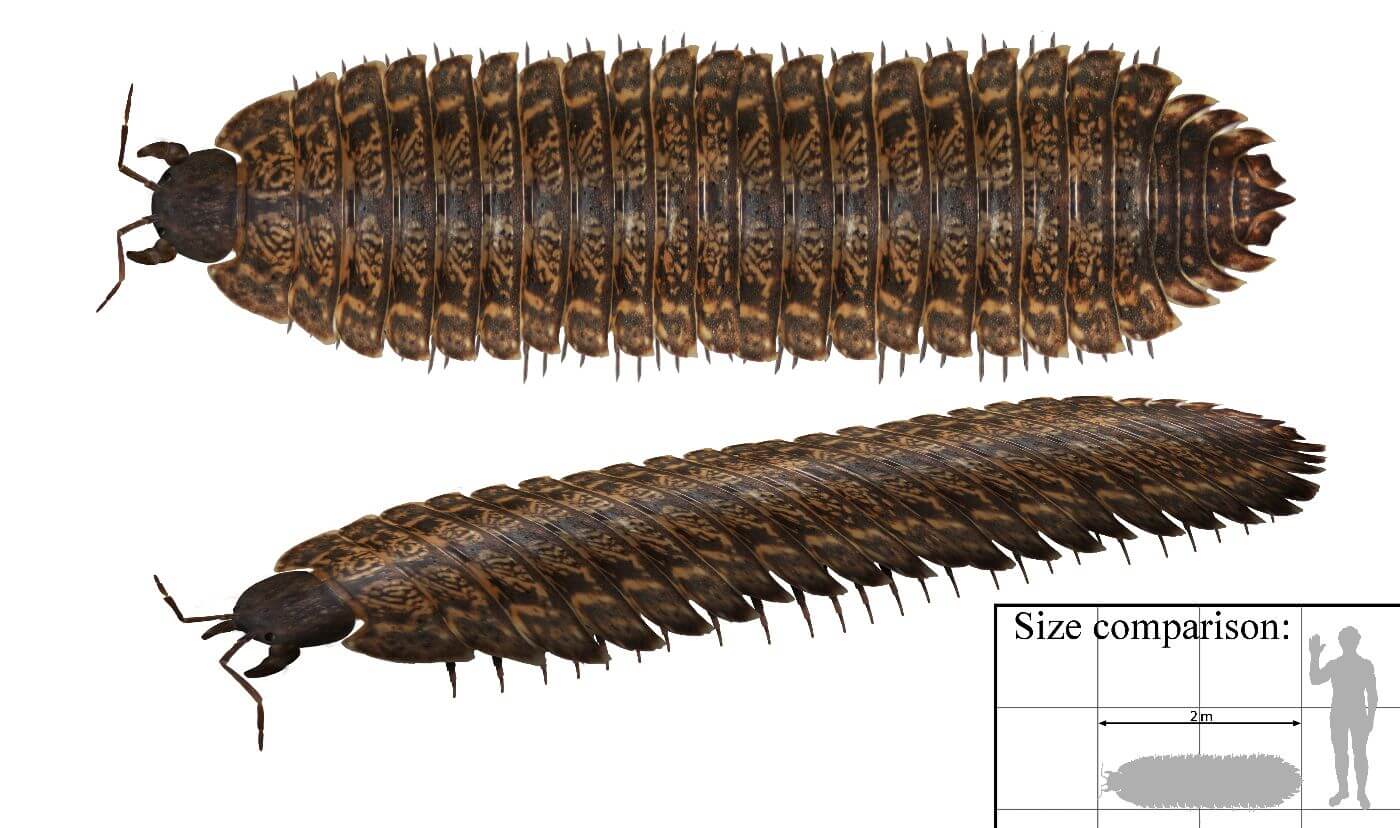
If regular millipedes give you the creeps, you really don’t want to know about Arthropleura. This absolute monster holds the record as the largest land dwelling arthropod in Earth’s entire history.
How big are we talking? Arthropleura grew up to 2.6 meters (about 8.5 feet) long and about 1.5 feet wide. That’s roughly the width of a small car. It weighed around 50 kilograms (110 pounds), which is about the same as a large dog.
This giant creature lived from the Carboniferous to early Permian periods, roughly 346 to 290 million years ago. Fossils have been found across Europe and North America.
Arthropleura had 28 to 32 body segments, with two pairs of legs attached to each segment. That means it had somewhere between 32 and 64 legs total. Its entire body was covered in thick, armored plates made of chitin.
Scientists recently made a creepy finding in 2024. New fossil analysis revealed that Arthropleura had stalked, crab-like eyes that stuck out from its head. This made the creature look even more alien and terrifying than researchers previously thought.
The good news? Arthropleura was probably a detritivore, meaning it mostly ate dead and rotting plant material on the forest floor. But honestly, that doesn’t make the idea of encountering an 8 foot armored millipede any less horrifying.
3. Pulmonoscorpius: The Cat Sized Scorpion
Modern scorpions are scary enough at just a few inches long. The largest living scorpion, the giant forest scorpion, reaches about 23 centimeters (9 inches). Now imagine a scorpion more than twice that size.
Pulmonoscorpius grew up to 70 centimeters (about 28 inches) long. That’s roughly the size of a domestic house cat. This prehistoric bug lived during the Early Carboniferous period, around 336 to 326 million years ago, in what is now Scotland.
Interestingly, all fossils of Pulmonoscorpius have been found at just one location: East Kirkton Quarry, about 20 miles west of Edinburgh. Back then, Scotland sat at the equator and was covered in vast tropical swamps.
This giant scorpion had all the terrifying features you’d expect: two grasping claws, eight spindly legs, and a powerful stinging tail. But it also had something modern scorpions don’t have: large lateral compound eyes.
These big eyes suggest that Pulmonoscorpius was a daytime hunter rather than a nocturnal creature. It also lacked adaptations for burrowing, which means it spent most of its time scuttling around on the surface, actively hunting for prey.
Picture a scorpion the size of your cat wandering across your living room floor in broad daylight. That’s the nightmare fuel Pulmonoscorpius represents.
4. Jaekelopterus: The 8 Foot Sea Scorpion
If Pulmonoscorpius sounds bad, Jaekelopterus is even worse. This creature holds the title of the largest arthropod that ever existed. Period.
Jaekelopterus measured between 2.3 and 2.6 meters (about 7.5 to 8.5 feet) long. If you include its extended claws, add another meter to that length. It lived during the Early Devonian period, approximately 390 to 400 million years ago.
Despite being called a “sea scorpion,” Jaekelopterus actually lived in freshwater environments. Fossils have been found in what is now Germany and Wyoming, in areas that were once rivers and estuaries. So even freshwater lakes and rivers wouldn’t have been safe from this prehistoric bug.
What made Jaekelopterus such an effective predator? Its giant chelicerae (claws) measured about 18 inches long and had well developed teeth for grabbing prey. It also had large compound eyes with excellent visual acuity, making it a highly effective hunter.
Scientists believe Jaekelopterus was an apex predator that hunted fish and other arthropods. Nothing in its environment could challenge a creature this size and this well armed.
Imagine going for a swim in a prehistoric river and seeing an 8 foot scorpion like creature with massive claws swimming toward you. That’s why we should all be grateful these things went extinct.
5. Hell Ants: The Scythe Jawed Vampires
Not all terrifying prehistoric insects were giants. The hell ants (scientific name Haidomyrmecinae) were only about half a centimeter long, but what they lacked in size, they made up for in pure nightmare design.
These ants lived during the Cretaceous period, between 113 and 79 million years ago. That means they walked the Earth alongside dinosaurs. Scientists have identified 16 different species of hell ants from amber fossils found in Myanmar, France, Canada, and Brazil.
What made hell ants so unique and terrifying? Their mandibles (jaws) moved vertically, swinging up and down instead of side to side like every other ant and almost every other insect. They’re the only insects ever known to have this feature.
Hell ants had scythe-like jaws and a horn-like protrusion sticking out of their foreheads. They used their bizarre jaws to swing upward and pin prey against this horn, then paralyzed victims with their well developed stingers.
One species, nicknamed “Vlad the Impaler” (Linguamyrmex vladi), had horns reinforced with metal to prevent its own bite from impaling itself. Other species had horns coated with serrated teeth.
The feeding behavior gets even creepier. Scientists believe hell ants fed their paralyzed prey to their larvae. Then, they may have made small cuts in the larvae’s soft bodies to drink their blood (called hemolymph in insects).
A 99 million year old amber specimen actually captured a hell ant in the middle of attacking an ancient cockroach relative. The predator and prey were frozen together forever in their final struggle.
6. Titanoptera: The Predatory Giant Crickets
Modern crickets are mostly harmless. They chirp, they hop, and some people even keep them as pets or feed them to reptiles. Their ancient relatives in the order Titanoptera were nothing like this.
Titanoptera had wingspans reaching 36 to 40 centimeters (14 to 16 inches). They lived from the Late Carboniferous through the Triassic period, roughly 310 to 200 million years ago. Fossils have been found in Kyrgyzstan, Australia, South Korea, and Russia.
These giant insects looked like oversized crickets or katydids, but they evolved as specialized predators. Unlike modern crickets that mostly eat plants, Titanoptera actively hunted other insects and possibly even small vertebrates.
Their front legs had evolved into raptorial limbs covered with stout spines, similar to a praying mantis. These grabbing arms were perfect for snatching prey. They also had elongated mandibles for consuming their victims.
Interestingly, Titanoptera couldn’t jump like modern crickets. Their hind legs were proportionally weaker and not built for leaping. Instead, these prehistoric insects were designed for ambush predation. They waited for prey to come close, then grabbed it with their spiny forelegs.
Scientists believe Titanoptera could produce deep, resonant sounds using specialized structures on their forewings. Imagine hearing that sound echoing through a prehistoric forest at night.
7. Giant Roachoids: The Carboniferous Cockroach Ancestors
People joke about how cockroaches can survive anything, and it’s partially true. The cockroach lineage has been around for over 300 million years. But today’s roaches are actually smaller than their ancient ancestors.
During the Carboniferous period, cockroach ancestors called roachoids were among the most common insects around. Scientists sometimes call this era the “Age of the Cockroach” because roachoid fossils are so abundant from this time.
Species like Archimylacris and Progonoblattina reached lengths of up to 9 centimeters (about 3.5 inches), with some having wings that measured 7.5 centimeters long. Fossils have been found worldwide, across Europe, North America, and beyond.
These ancient roaches had some features that modern cockroaches don’t have. Females had long external ovipositors for inserting eggs into substrates. They could also fly with their well developed wings, making them even harder to escape.
Giant roachoids were fast runners with sticky pads called euplantulae on their legs. These pads let them climb smooth surfaces like leaves and tree bark. They also had claws at the base of their legs for gripping rough surfaces.
Like modern cockroaches, these prehistoric bugs were scavengers. They spent their days scurrying across forest floors, eating pretty much anything rotting they could find, including dead plants, dead insects, and animal remains.
If regular cockroaches are hard to get rid of, imagine dealing with flying roaches the size of your hand that could climb any surface.
8. Mazothairos: The Six Winged Giant
Most flying insects have four wings. Mazothairos had six.
This bizarre creature had an estimated wingspan of 56 to 85 centimeters (22 to 33 inches), putting it among the largest flying insects ever. It lived during the Late Carboniferous period, approximately 309 million years ago. The only known fossils come from the famous Mazon Creek fossil beds in Illinois.
Mazothairos belonged to an extinct order called Palaeodictyoptera. What made these creatures unique was their extra pair of small winglets located on the prothorax, in front of their main wings. This gave them a total of six wings.
Scientists believe this six wing design would have given Mazothairos incredible mobility in the air. It could have maneuvered in ways that four winged insects simply couldn’t match.
The feeding apparatus was equally strange. Mazothairos had sharp, beak-like piercing mouthparts with elongated stylets. It used these to pierce plant tissue and suck out the liquids inside. Think of it like a giant flying mosquito, except it targeted plants instead of animals.
Very little is known about Mazothairos because only fragmentary fossils exist. But what scientists have found paints a picture of one of the strangest and largest flying insects to ever exist.
Why We Should Be Grateful They’re Gone
Today’s insects can certainly be annoying. Mosquitoes bite, wasps sting, and cockroaches invade kitchens. But compared to these prehistoric monsters, modern bugs are nothing.
These ancient creatures couldn’t survive in today’s world even if they wanted to. The lower oxygen levels in our atmosphere (21% versus the Carboniferous 35%) simply wouldn’t support bodies that large. Insects breathe through a system of tubes called tracheae, and bigger bodies need more oxygen to function.
Climate change also played a role in their extinction. As the Carboniferous rainforests collapsed and the climate became drier, many of these giant species couldn’t adapt. The rise of reptiles and eventually birds created new competition and predators that these slow moving giants couldn’t handle.
So the next time a regular sized spider or cockroach makes you jump, just remember: it could be so much worse. At least you don’t have to worry about 8 foot millipedes crawling through your backyard or hawk sized dragonflies hunting overhead.
The age of giant prehistoric insects is over, and honestly? That’s probably for the best.