
If you’ve just found a pile of dark pellets in your crawlspace or near your bird feeder, your first instinct is probably a mix of “gross” and “what is that?” Identifying the culprit immediately is a big deal because a squirrel in the attic is a different beast entirely than a rat infestation in the walls.
Telling squirrel poop vs rat poop apart isn’t just about being a detective, it’s about knowing which traps to buy and which holes to plug. While they look similar from five feet away, the details tell a very different story.
Table of Contents
Visual Comparison Table: Squirrel Poop vs Rat Poop
Use this table as your quick field reference whenever you come across mystery droppings.
| Feature | Squirrel Droppings | Rat Droppings |
| Length | 3/8 inch to 1/2 inch (8–12 mm) | 1/2 inch to 3/4 inch (12–19 mm) |
| Width | About 1/8 inch (3 mm) | About 1/4 inch (6 mm) |
| Pellet shape | Barrel-shaped, blunt rounded ends | Capsule-shaped, tapered or pointed ends |
| Texture | Smooth, firm surface | Slightly rough or uneven surface |
| Fresh color | Dark reddish-brown to black | Shiny black or very dark brown |
| Aged color | Fades to light brown or gray | Turns dull gray or chalky white |
| Smell | Mild, faintly musty | Stronger, ammonia-like odor |
| Common locations | Gardens, near trees, bird feeders, decks | Attics, along walls, near food storage |
| Quantity pattern | Scattered individually, rarely clustered | Found in groups, often along regular trails |
If the infestation gets out of your control, you can hire Orkin for pest control services.
Detailed Breakdown: Squirrel Droppings
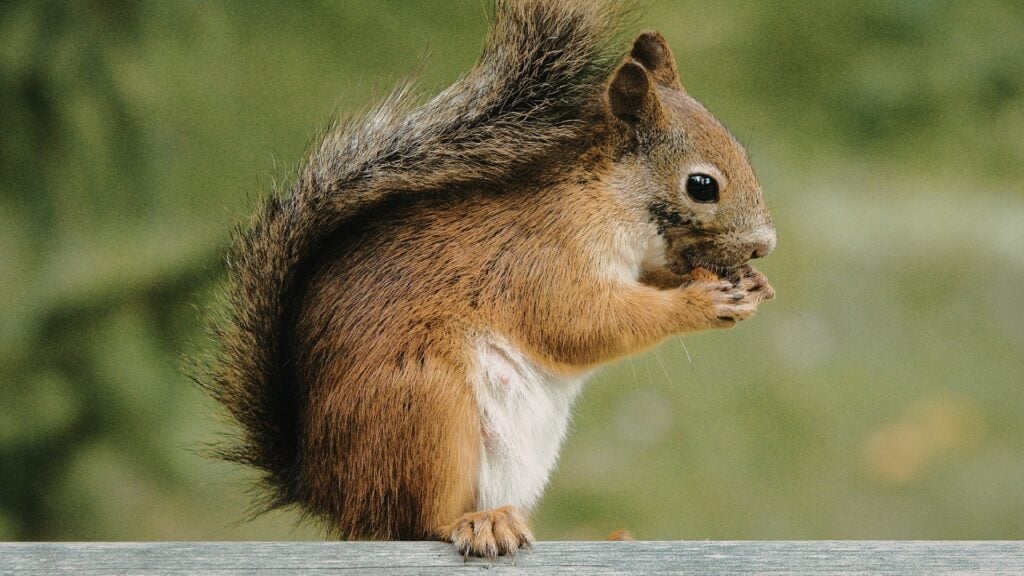
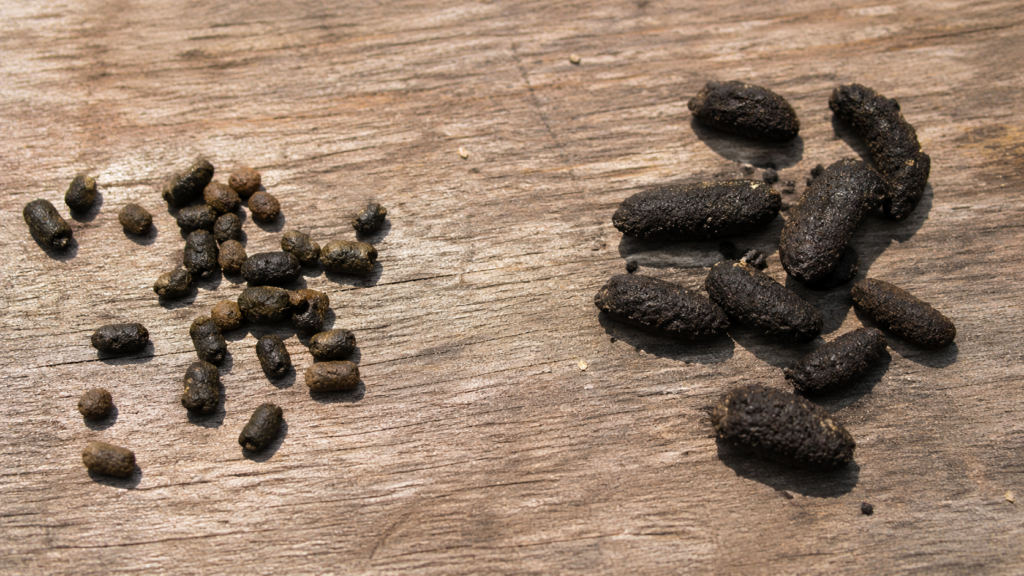
To understand squirrel scat properly, you have to get specific. Squirrel droppings typically measure between 3/8 inch and 1/2 inch in length, with a width of roughly 1/8 inch. That droppings size puts them on the smaller end compared to most rat species, which is a helpful first filter when you are sorting through what you found.
The pellet shape is one of the most reliable identifiers. Squirrel droppings have blunt, rounded ends on both sides. This, in turn, gives them a barrel or cylindrical look. They are uniform in shape across the entire dropping, with no tapering at either end. Under magnification, squirrel scat has a smooth outer surface with a compact, dense texture. There are no rough grooves or irregular edges like you might see with rat feces.
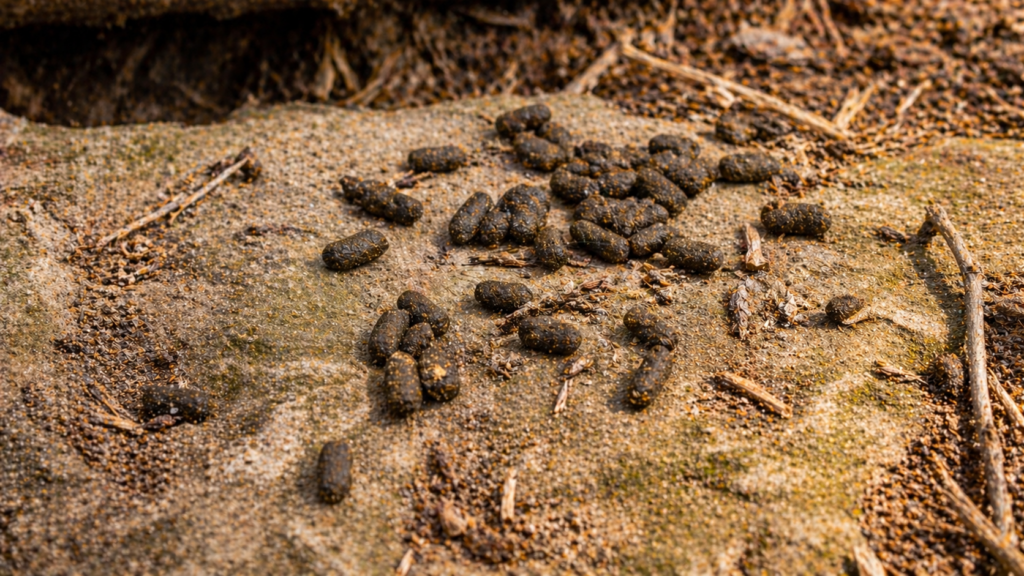
The color difference between fresh and old squirrel droppings is significant. Fresh droppings are reddish-brown to dark chocolate brown, sometimes almost black, depending on what the squirrel has been eating. As they age over a few days to a week, they lighten noticeably, shifting to a pale tan or grayish-brown tone. That color shift is actually useful because it helps you figure out whether an infestation is active or old.
When it comes to location clues, squirrels are fairly predictable. You will find their droppings near bird feeders, under oak or walnut trees, along fence lines, on deck railings, and scattered across garden beds where they have been foraging. Garden poop from squirrels tends to be scattered randomly across an area rather than deposited along a defined path, which reflects how squirrels move compared to rats.
Detailed Breakdown: Rat Droppings
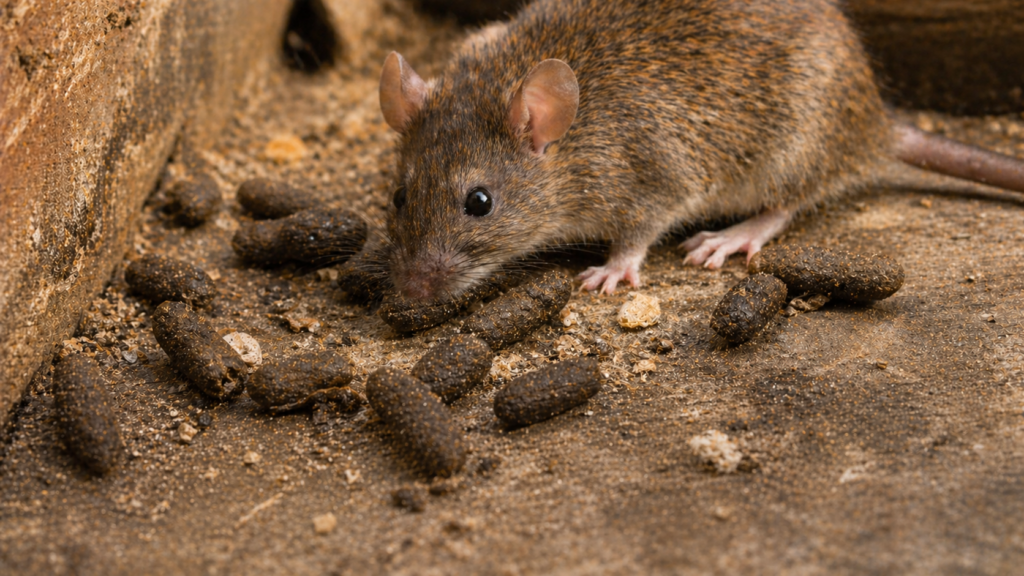
Rat feces identification gets a little more layered because you have two common species to consider: the Norway rat and the Roof rat, and their droppings are slightly different from each other.
Norway rat droppings are the larger of the two, typically measuring 3/4 inch in length with blunt ends and a thick, capsule-like shape. Roof rat droppings are smaller and more pointed, averaging about 1/2 inch in length with distinctly tapered ends. Both species produce droppings that are noticeably larger and heavier-looking than squirrel droppings, which is one of the first things you will notice when doing a side-by-side rodent poop comparison.
The pellet shape on rat droppings has a tapered, spindle-like quality. One or both ends come to a soft point rather than a rounded, blunt tip. The surface texture is also rougher than squirrel droppings, with slight irregularities along the outer shell. Under close inspection, you can often see small ridges or an uneven grain to the surface.
Fresh rat feces are dark, almost glossy black, with a shiny surface that catches light. That shine fades quickly. Within 48 to 72 hours, rat droppings lose their glossiness and turn a flat, matte dark brown. After a week or more, they dry out completely and shift to a chalky gray or dull white, which is a sign the infestation may not be current.
For attic droppings identification, rats are a far more common culprit than squirrels. Norway rats tend to stay low, so you will find their pest evidence along baseboards, inside cabinets, behind appliances, and near floor-level food storage. Roof rats, as the name suggests, favor elevated spaces, so attic droppings, rafters, and wall voids are their preferred deposit zones. Finding droppings in tight linear trails along a wall edge is a strong indicator you are dealing with rats, not squirrels.
Key Similarities Between Squirrel Poop and Rat Poop
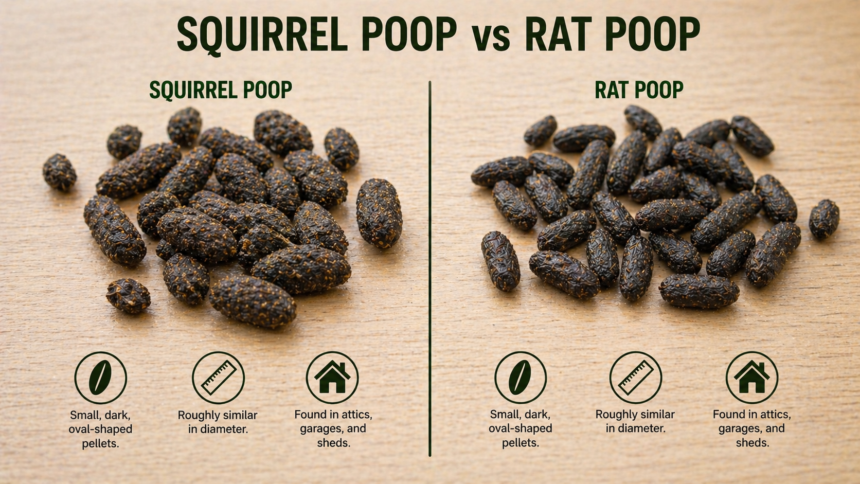
Here is the honest truth: squirrel droppings vs rat droppings do share enough traits to cause real confusion, especially when you find just a few scattered pieces with no other context.
- Both produce small, dark, oval-shaped pellets.
- When fresh, both are nearly identical in color, ranging from dark brown to black.
- Both are roughly similar in diameter when comparing a small Norway rat to a large squirrel.
- Both types of fecal matter are odorless from a distance and only produce a detectable smell up close.
- Both can be found in attics, garages, and sheds under the right circumstances.
The overlap is real, which is why relying on a single characteristic to make your identification is risky. You need to look at size, shape, location, and pattern together as a complete picture before drawing a conclusion.
7 Reliable Ways to Tell Them Apart in Real Life
1. Size Comparison with Reference Objects
Hold the dropping next to a standard raisin or a grain of rice. Squirrel droppings are roughly raisin-sized, while rat droppings from a Norway rat are noticeably longer and fatter, closer to the size of an olive pit.
2. Shape and End Texture
Roll the dropping gently with a gloved finger or a stick. Squirrel droppings feel uniformly cylindrical with two blunt round ends. Rat droppings taper toward one or both ends, like a small spindle or a stretched capsule.
3. Location and Trail Patterns
Squirrels scatter droppings loosely across open areas. Rats follow fixed routes and deposit along walls, pipes, and ledges in consistent trails. If the droppings form a line against a baseboard or wall edge, that is a rat pattern.
4. Amount and Clustering
A single squirrel deposits around 80 droppings per day, but they are spread across a wide foraging area. Rats produce 40 to 50 droppings per day in concentrated clusters near nesting or feeding spots. Dense clusters in one small area point strongly toward rats.
5. Presence of Other Evidence
Check nearby surfaces for gnaw marks. Rats gnaw constantly and leave visible chew damage on wood, plastic, and wiring. Squirrels also gnaw, but their marks tend to appear on exterior wood, nuts, or outdoor structures rather than interior walls and wires.
6. Smell Test
Get close carefully, without touching. Rat-infested areas carry a sharp, ammonia-heavy urine smell. Squirrel areas are much milder and have a faint musty or earthy odor. If the smell hits you before you even get close to the droppings, it is almost certainly rats.
7. Seasonal Patterns
Squirrel activity spikes in fall when they are caching food and in early spring. Rats are active year-round, with no seasonal slowdown. Finding droppings in winter when squirrels are relatively dormant is a strong indicator that rats are responsible.
Health Risks and What to Do If You Find Droppings
Both types of droppings carry genuine health risk, so treat all unknown fecal matter as hazardous. Rat scat is linked to Hantavirus, leptospirosis, and salmonella. Squirrel droppings can carry salmonella and leptospirosis as well. Never sweep or vacuum dry droppings, as this releases particles into the air.
Spray the area with a disinfectant solution, let it soak for five minutes, then wipe with disposable gloves and a mask on. Bag everything, seal it, and wash your hands thoroughly. If you have found large quantities of attic droppings, contact a licensed pest control professional for safe remediation.
Frequently Asked Questions (Squirrel Poop Vs. Rat Poop)
Can squirrel poop look exactly like rat poop?
Yes, in some cases it can, especially when comparing a large squirrel to a small Roof rat. The size overlap is real, and fresh color is nearly identical for both. That is exactly why you should never rely on appearance alone. Location, trail patterns, and supporting evidence like gnaw marks or tracks will give you the full picture.
Do squirrels poop in the same place repeatedly?
Not in the way rats do. Squirrels do not establish fixed latrine zones like some animals. They defecate while foraging, feeding, or moving through their territory, so their droppings are spread across a wide area. You may find heavier concentrations near a bird feeder or under a nut tree, but there is no tight, repeated deposit site the way you see with rats.
Is rat poop more dangerous than squirrel poop?
From a disease standpoint, rat droppings carry a higher overall risk. Rats are closely associated with Hantavirus, which is serious and sometimes fatal, and they are more likely to contaminate food storage areas directly. Squirrel scat poses health risks too, but rats have a longer documented list of zoonotic diseases tied to their fecal matter. Either way, both should be handled with the same level of caution.
What does fresh squirrel poop look like?
Fresh squirrel poop is dark reddish-brown to near-black, smooth, and slightly soft to the touch. It has a barrel shape with two blunt rounded ends. Within a few days it begins to dry out and lighten in color toward tan or pale gray. If you find droppings that are still dark and slightly moist, the squirrel activity is current and likely ongoing.
How do I clean attic droppings safely?
Ventilate the space first by opening any available vents or windows. Put on an N95 mask, disposable gloves, and old clothes you can wash immediately afterward. Spray all droppings and the surrounding area with a bleach-based disinfectant or an enzyme cleaner, wait five minutes, then wipe everything up with paper towels. Place all waste in a sealed plastic bag. Never dry sweep or vacuum without a HEPA filter, as airborne particles carry the biggest disease risk.
Wrapping Up…
When it comes to squirrel poop vs rat poop, the differences are real and identifiable once you know what to look for. Size, pellet shape, end texture, color change over time, location, and trail pattern all work together to give you a clear answer. Rats leave larger, pointed droppings in linear trails near walls and food sources. Squirrels leave smaller, barrel-shaped droppings scattered across open foraging areas. Use this guide as your go-to field reference, and when in doubt, bring in a professional. Getting the identification right the first time is always worth it.