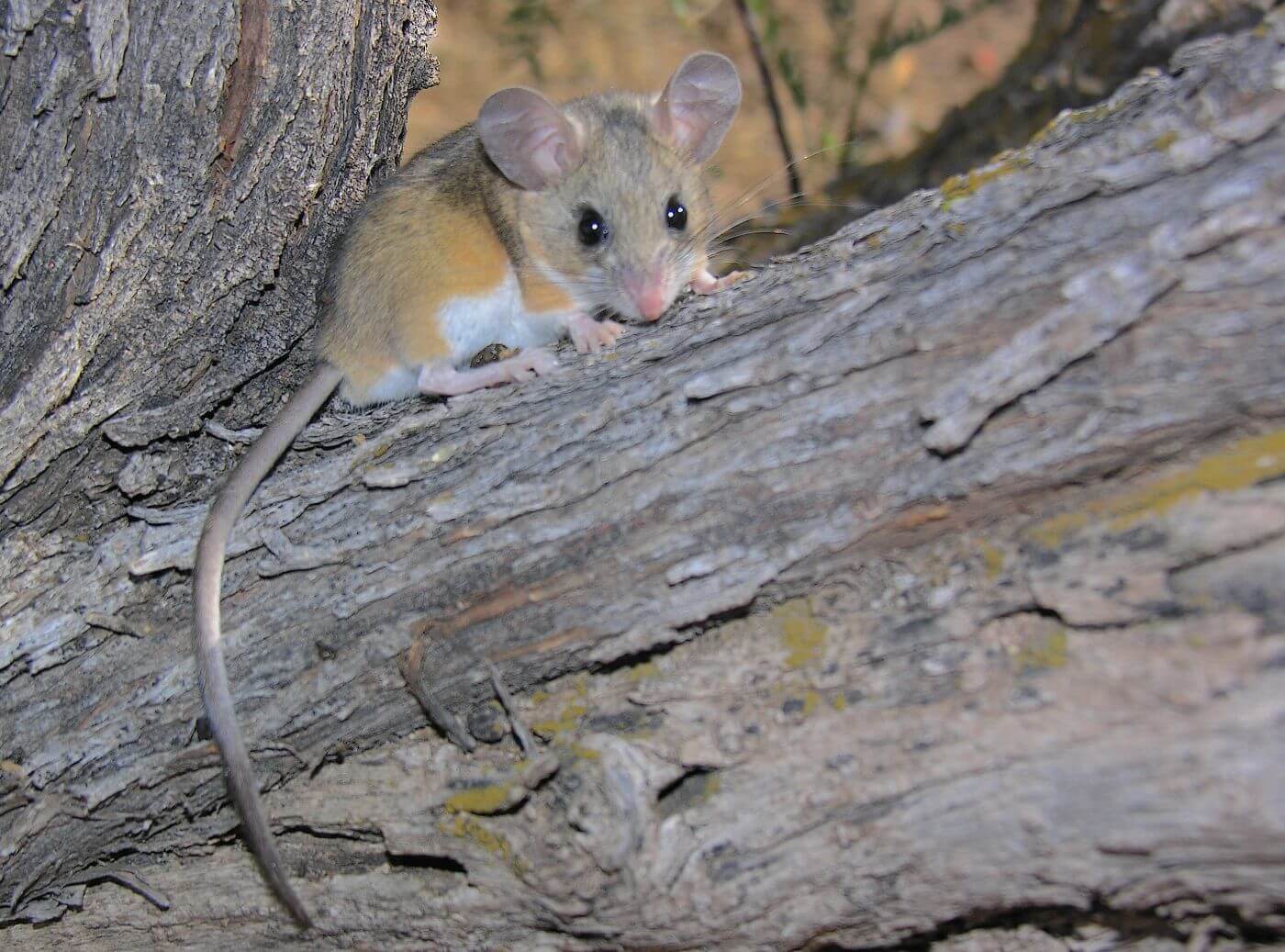


Most people hear something scratching behind a wall and immediately assume the worst without actually knowing what they are dealing with. The distinction between mice vs rats is clearly important cause both rodents behave differently, nest differently, respond to different traps, and carry different levels of health risk.
Treating a rat problem like a mouse problem, or the other way around, is one of the most common reasons DIY pest control fails. With solid research and years of experience, we are here to walk you through every reliable identification method available, from physical features and droppings to behavior patterns and infestation signs, so you can figure out exactly what has moved into your home and deal with it the right way from the start.
Table of Contents
Physical Differences: The Visual Identification Guide
Size and Weight

When it comes to house mouse identification, size is the most obvious factor, but it can also be the most misleading. A full-grown house mouse is quite small, usually measuring between two and four inches long.
If you place a mouse next to a common object, it is roughly the size of a travel-size tube of toothpaste. On the other hand, an adult Norway rat or a roof rat is much larger and more intimidating. These rats can grow up to nine or ten inches in length, not including their tails. A big rat can easily weigh ten times more than a mouse, often reaching the size of a standard glass soda bottle.
Ear Shape and Head Structure
Mouse ears are large relative to their head size, rounded, and prominent. If you look at a mouse straight on, the ears seem almost oversized for the face. Rat ears are smaller proportionally, sit closer to the head, and look more restrained against a broader skull.
The overall head shape reinforces this difference. Mice have a narrow, triangular face that tapers sharply. Rats have a heavier, broader head with a more blocky jaw structure that reflects their considerably greater bite force.
Tail Length and Texture
A mouse tail is thin, lightly haired, and roughly equal to or slightly longer than its body length. It has a uniform, cord-like appearance. A rat tail is thick, scaly, hairless, and distinctly segmented in appearance. Norway rat tails are typically shorter than the body length. On the flip side, roof rat tails are longer than the body and taper to a finer point. The texture difference is straight away apparent on close inspection. A mouse tail feels almost delicate. A rat tail has a rough, almost reptilian surface.
Nose Shape and Snout
Mouse snouts are pointed and narrow, and it’d, in turn give the face a sharp, almost triangular silhouette from the side. Rat snouts are blunter and broader, with a more rounded nose tip that fits the generally heavier head structure.
This difference in nose shape is useful when you are dealing with a rodent that is moving quickly, and you only get a partial view. The pointed snout of a mouse is a reliable identifier even in low light.
Fur Color and Texture
House mice are typically gray or light brown on the back with a slightly paler belly, and the fur has a fine, smooth texture. Some house mice show a dusty gray tone that makes them blend well against concrete and drywall.
Norway rats tend toward brown or gray-brown with scattered black hairs through the coat and a pale gray or white belly. Roof rats are generally darker, sometimes nearly black on the back, with a lighter belly. Rat fur feels coarser and denser than mouse fur across both species.
Feet and Tracks
Mouse footprints measure around 3/8 of an inch and show four toes on the front feet and five on the back. Rat footprints run considerably larger, between 3/4 of an inch and one full inch, with the same toe configuration but a heavier, more spread impression. In dusty areas or along tracked surfaces, footprint size alone can confirm which rodent you are dealing with before you ever see the animal itself.
Droppings Comparison: The Most Reliable Clue
Droppings are the single most reliable identification tool available to homeowners, and learning to read them correctly saves a significant amount of time and money on treatment.
Droppings size is the starting point. Mouse droppings measure between 1/8 and 1/4 of an inch in length, roughly the size of a grain of rice. Norway rat droppings run between 3/4 and one inch and are considerably thicker than mouse droppings. Roof rat droppings are slightly smaller than Norway rat droppings but still noticeably larger than anything a mouse produces.
| Feature | House Mouse | Norway Rat | Roof Rat |
| Length | 1/8 to 1/4 inch | 3/4 to 1 inch | 1/2 to 3/4 inch |
| Shape | Thin, pointed both ends | Blunt, capsule shape | Slightly curved, tapered |
| Fresh color | Dark brown to black | Dark brown to black | Dark brown to black |
| Aged color | Gray or chalky | Gray or chalky | Gray or chalky |
| Quantity per day | 50 to 80 droppings | 40 to 50 droppings | 40 to 50 droppings |
| Location pattern | Scattered widely | Concentrated along walls | Found in elevated areas |
Fresh droppings from any species are dark, slightly soft, and carry a shiny surface. As they age over 48 to 72 hours, they dry out, lose their shine, and fade toward gray or chalky white. Finding a mix of fresh dark droppings and older faded ones tells you the infestation is active and ongoing rather than historical.
Mouse droppings vs rat droppings differ most clearly in location pattern. Mice scatter droppings broadly across their foraging area because they move in short exploratory bursts from a central nest. Rats tend to concentrate droppings along fixed travel routes and thereby create denser accumulations in fewer locations. Finding a consistent line of large droppings along a wall edge or behind an appliance strongly points toward rats.
Behavior and Habitat Differences
- Nesting habits: House mice build nests from shredded soft materials including paper, insulation, and fabric, typically inside walls, inside furniture, or in stored boxes. Norway rats nest in burrows underground, under concrete slabs, and in low crawl spaces. Roof rats prefer elevated nesting sites, including attic insulation, wall voids near the roofline, and dense vegetation.
- Climbing ability: Mice are agile climbers and can scale rough vertical surfaces with ease, though they tend to stay relatively close to floor level in daily movement. Roof rats are exceptional climbers, regularly traveling along utility lines, tree branches, and roof edges to access upper entry points. Norway rats are ground-dwellers and poor climbers by comparison.
- Activity times and range: Both mice and rats are primarily nocturnal, but mice operate in a much smaller territory, typically staying within 10 to 30 feet of their nest. Rats cover a much wider range, up to 300 feet from their nest in a single night, which means a rat infestation can affect a significantly larger area of a property.
- Gnaw marks: Mice leave smaller, cleaner gnaw marks with fine tooth striations on food packaging, wood, and soft materials. Rats produce larger, rougher gnaw marks with visible parallel grooves from their substantially stronger incisors. Rat gnaw damage on structural wood, plastic pipes, and electrical wiring is more severe and develops faster than equivalent mouse damage.
- Food preferences: Mice are nibblers that prefer grains, seeds, and cereal products, taking small amounts from many locations across their territory. Rats are more opportunistic and powerful feeders that consume larger quantities per sitting and will take on harder food sources including bones, leather, and thick plastic containers.
- Breeding rate: A house mouse reaches sexual maturity at around six weeks and can produce eight to ten litters per year with five to six pups per litter. A single pair of mice can theoretically produce over 200 offspring in a year under ideal conditions. Norway rats mature slightly slower at around three months but still produce four to six litters annually with seven to twelve pups each. Both rodents breed fast enough that a small initial population becomes a serious infestation within weeks if left unaddressed.
Signs of Mice vs Rat Infestation
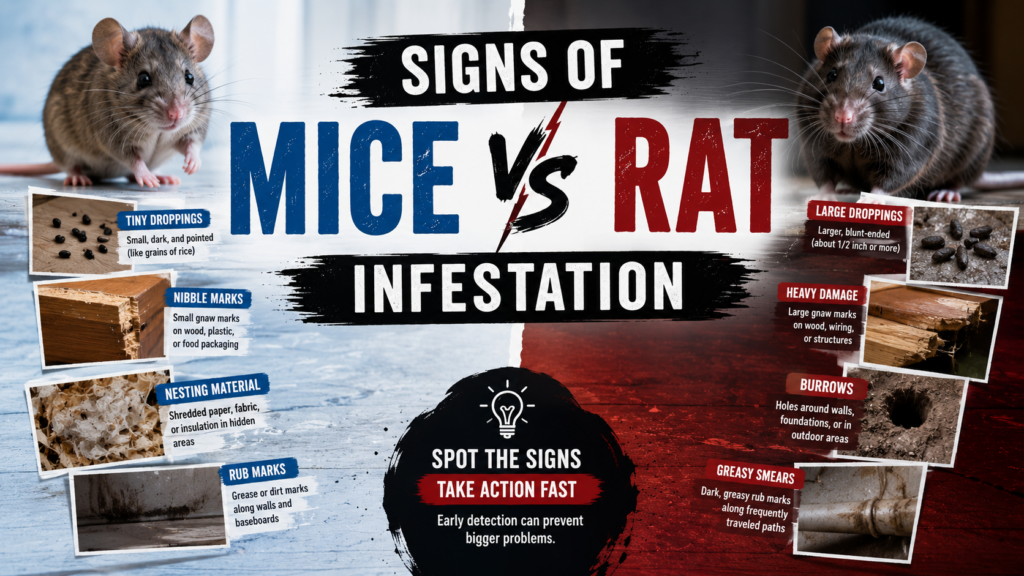
Identifying which rodent you have based on secondary evidence speeds up your response time considerably.
Signs pointing toward mice: Small dark droppings scattered across countertops, inside drawers, and along baseboards. Fine gnaw marks on food packaging and soft wood. Small nests built from shredded paper or fabric tucked into corners of drawers or storage boxes. A faint musky odor in enclosed cabinet spaces. High-pitched squeaking sounds from inside walls, most common at night. Smudge marks along baseboards where mice repeatedly travel the same path.
Signs pointing toward rats: Large droppings concentrated along wall edges and behind appliances. Visible burrow holes near the foundation exterior or under concrete pads. Heavy gnaw damage on structural materials, plastic pipes, or thick cardboard. A stronger, more ammonia-forward urine odor in affected areas. Grinding or thumping sounds from inside walls or the attic at night. Grease marks along rafters, pipes, or wall edges where rats repeatedly travel the same route.
Sounds matter for location as much as species. Scratching sounds from inside walls at floor level generally indicate mice or Norway rats. Sounds from the ceiling or upper wall cavities lean toward roof rats or occasionally mice that have climbed into the upper structure.
Health Risks: Mice vs Rats
Both rodents carry diseases that pose genuine risks to humans, and neither one should be treated casually because of its size.
Mice are the primary carrier of hantavirus in the United States, specifically through deer mouse droppings, urine, and saliva. Hantavirus pulmonary syndrome causes critical respiratory failure in roughly one-third of patients who develop full symptoms, making it one of the more dangerous rodent-borne diseases on the continent. Mice also transmit salmonella through contaminated food surfaces and leptospirosis through urine contact.
Rats carry leptospirosis at high rates, spread through their urine into water sources and soil. They are also implicated in salmonella transmission and historically in the spread of disease through ectoparasites like fleas. Seoul virus, a hantavirus strain that causes hemorrhagic fever with renal syndrome, is carried by Norway rats worldwide including in the United States.
The practical takeaway is that mouse droppings in kitchen spaces carry a real hantavirus risk that most homeowners significantly underestimate, and rat urine contamination of water or food contact surfaces carries leptospirosis risk that is equally underappreciated. Both rodent types demand proper protective equipment during clean-up, including gloves and an N95 respirator at minimum.
Control Methods: Species-Specific Strategies and Which Pest Control Company to Call
A one-size-fits-all approach to rodent control fails regularly because the behaviors, entry points, and trap responses of mice vs rats are fundamentally different.

For mice: Snap traps placed perpendicular to walls with the trigger end facing the baseboard are the most consistently effective control tool. Mice are curious and will investigate new objects in their territory within one to two days of placement. Use peanut butter or chocolate as bait in small quantities. Place traps every 2 to 3 feet along active travel routes for best coverage. Glue boards work as supplementary monitoring tools but are not a primary control method.

For rats: Rats are neophobic, meaning they avoid new objects in their environment for several days before approaching them. Place unset traps baited with food for three to four days before setting them to allow the rats to habituate. Large snap traps rated for rats are necessary since mouse-sized traps will not hold or kill a rat reliably. Bait stations with rodenticide blocks are effective for Norway rat populations in exterior perimeter applications under professional supervision.
Entry point sealing differs by species. Mice can enter through gaps as small as a quarter inch, so sealing requires attention to every pipe penetration, utility line gap, and door threshold. Rats need a gap of at least half an inch, but their jaw strength means soft sealants alone are insufficient. Steel wool packed into gaps followed by hardware cloth or metal flashing provides the barrier strength needed against rat entry.
For large or persistent infestations, calling a licensed pest control professional is the correct move. Companies like Orkin and Angil offer rodent-specific treatment programs with trained technicians who can identify the species accurately, locate entry points through a full exterior inspection, and deploy targeted control measures that account for the behavioral differences between mice and rats.
Frequently Asked Questions (Mice vs Rats)
Can a mouse turn into a rat?
A mouse cannot turn into a rat. They are entirely separate species with different genetics, body structures, and behaviors. The confusion often comes from seeing a juvenile rat and misidentifying it as a large mouse. A young rat will have noticeably larger feet and a thicker tail relative to its body size compared to an adult mouse, which is the most reliable way to tell a juvenile rat from a full-grown mouse.
Do mice and rats live together?
Mice and rats generally do not coexist comfortably in the same space. Rats will actively prey on mice when they encounter them, and mice instinctively avoid areas where rat odor is present. Finding evidence of both species in the same property is possible if the building is large enough to give each population separate territory, but active overlap in the same small space is uncommon.
Which is worse, mice or rats?
Both create serious problems, but in different ways. Mice reproduce faster and access tighter spaces, making them harder to fully exclude from a home. Rats cause more structural damage per individual animal and carry leptospirosis at higher rates in urban environments. Mice present a higher hantavirus risk in rural and semi-rural settings through deer mouse populations specifically. Neither is a good houseguest, and the real answer depends on your specific location and the damage profile you are seeing.
How do I know if I have baby rats or mice?
Juvenile rats have proportionally larger feet, thicker tails, and a broader head relative to body size compared to adult mice. An adult house mouse has large ears that look prominent against the head. A baby rat has smaller, more folded ears and a snout that already shows the blunter rat profile even at a young age. If in doubt, the foot size relative to body length is the most consistent differentiator.
Are rat droppings bigger than mouse droppings?
Rat droppings are considerably larger than mouse droppings across every measurement. A Norway rat dropping is roughly four to six times the length and significantly wider than a house mouse dropping. Roof rat droppings sit between Norway rat and mouse size but still far exceed anything a mouse produces. Droppings size comparison is one of the fastest and most reliable identification methods available without ever seeing the live animal.
Wrapping Up…
Getting the identification right between mice vs rats is the foundation of any effective pest response. The physical differences are real and consistent once you know what to look for, from ear shape and snout structure down to tail texture and foot size. Droppings tell you not just which species you have but whether the infestation is active, how large it might be, and where the animals are spending most of their time. Behavior and habitat differences tell you where to focus your control efforts. Understanding how to tell mice from rats accurately at the start saves you time, money, and the frustration of applying the wrong solution to the wrong problem. Take the identification seriously, act on it quickly, and bring in a professional when the situation is beyond what traps and sealant can handle on their own.